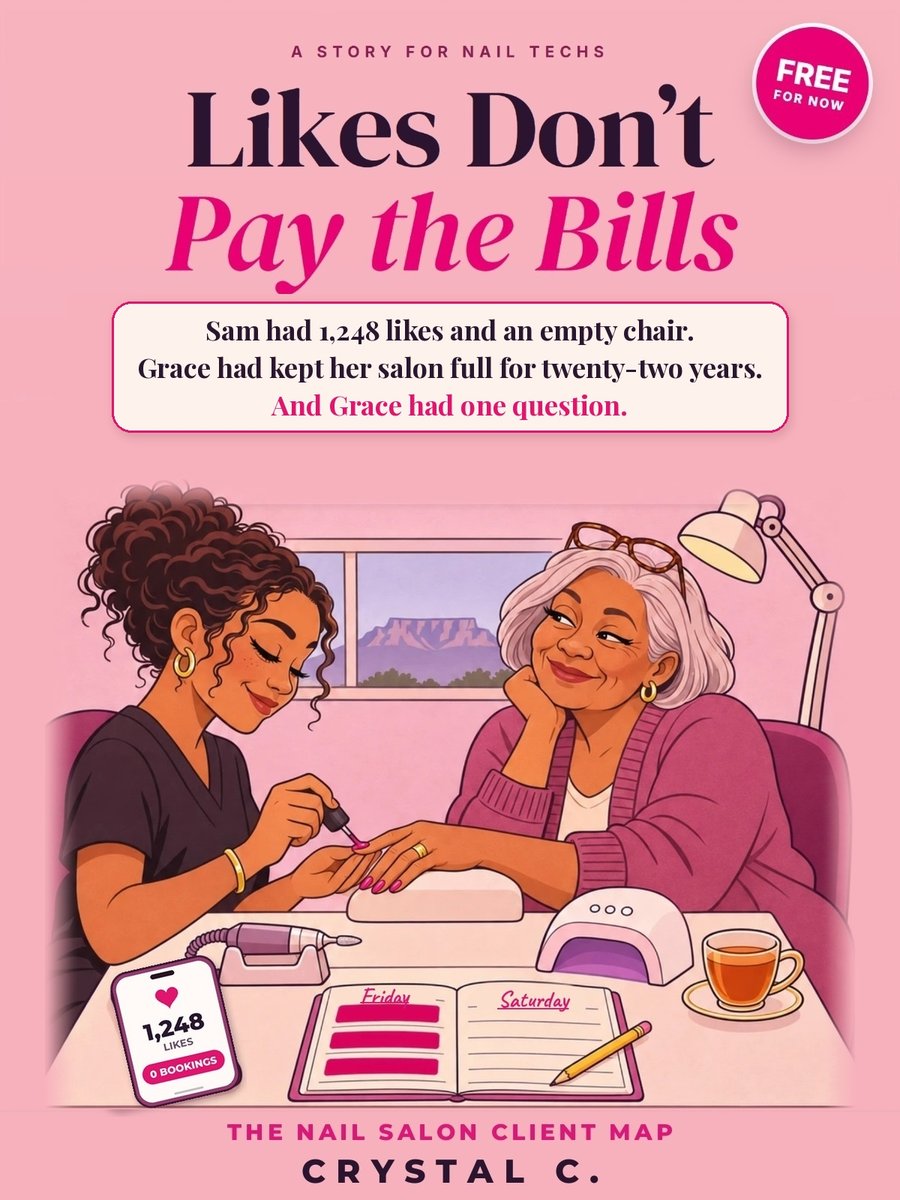
Every day we talk to nail techs who do beautiful work and still lie awake worrying about money. Most of them don't need new equipment to start improving. They need someone to sit down with them, kindly, and look at their numbers.
That's what Grace did for a young nail tech called Sam. We'd like you to meet them both.
The Crystal Clawz Team
Before we start
You're good at nails, but the money feels tight. This book is for you. Grab a notebook and a pen.
At Crystal Clawz, we see nail techs doing beautiful work and still struggling to pay the bills. We wrote this book because good nails deserve a good business behind them. Grab your notebook. Let's go meet Sam.
Read the full intro
You're good at nails. Your clients tell you so. Your photos show it.
So why does the money feel so tight?
If that sounds like you, this book is for you. Maybe you work from a room at home, or a corner of your lounge. Maybe you've only just registered your business.
Maybe numbers make your stomach turn a bit. That's fine. You don't need to be good at maths to use this book. You just need a notebook and a pen.
Every three weeks, while Sam does Grace's nails, Grace asks her one more question about her business.
Over the months from February to December, you'll watch Sam take home a lot more money each month. She does it from the same room, with the same lamp and the same chair.
- At the start: R9 200 a month
- By the end of the book: R16 504 a month
She doesn't need new equipment, but she still buys replacement supplies as she uses them.
She also gets things wrong. In every chapter she tries something that doesn't work, and you'll see what it cost her and what she did next. You'll learn as much from her mistakes as from what worked.
The five boxes
Everything in this book comes down to five boxes. Every nail business in the world runs on them:
People who ask × How many book × How often they come back × What they spend × What you keep
See the × signs? The boxes don't add up. They multiply. That's the big idea behind the book.
Here's a simple example. Make each box a little better, and watch what happens to your money:
| Your money | |
|---|---|
| Where you are now | R100 |
| 10% more people ask | R110 |
| …and 10% more of them book | R121 |
| …and they come back 10% more often | R133 |
| …and spend 10% more each visit | R146 |
| …and you keep 10% more of each rand | R161 |
Each box 10% better gives about 61% more, not 50%!
This is an illustration, not a guarantee. You must have time for extra work and actually achieve the savings.
How to use this book
Each chapter follows Sam as she works on one box:
- More people asking: getting found by people who can actually come to you
- More people booking: answering messages so that people who ask end up booking
- Coming back sooner: keeping the clients you already have
- What each visit is worth: charging for the work you already do
- What you keep: discounts, waste and prices, and how the five boxes multiply
- Sam writes her plan: turning your real numbers into a plan you can take to a funder
Every idea in Chapters 1 to 5 costs you nothing, or next to nothing, to try. No new tools, no ads, no courses. You can start this week with what you already have. And we'll always show you what an idea costs as well as what it brings in.
Each chapter ends with a Your turn box: a few small things to try this week, and one number to check in the free Know Your Numbers planner.
Don't try to do everything at once. Pick one thing. Do it. Then come back for the next one.
As you read, look out for:
- Notebook pages: what Sam writes down with her pen.
- Yellow notes: Sam's numbers, taken out of the story so you can read on, or stop and check them.
- "How Sam counted this": the small print. Tap it if you want the detail.
Sam's numbers are fictional and reconciled. Here, take-home is money left after products and business bills, before personal tax and savings.
How Sam's numbers are counted (small print)
The planner separates your pay from profit after your pay. Don't count take-home as profit or subtract your pay twice.
Stock on the shelf is not free. These tables count the cost of products used, even if Sam bought them earlier. More appointments use more supplies. Her starting R40 average includes gel, files, wipes, sanitiser, waste and free fixes. It is an example allowance, not a Crystal Clawz price quote. Buying stock affects her bank balance; using it affects what she earns. Don't subtract both from the same profit calculation.
The chapter tables count products used and business expenses, not the exact bank balance on a date. The R80 cards and failed R300 advert are counted once in Chapter 1's month, not repeated in every month's bills. Equipment, bulk stock purchases and money set aside for savings also need their own cash plan.
Meet Sam and Grace
Sam
Does nails from the back room of her mom's house in Goodwood, Cape Town. Her work is beautiful, but her book has gaps, and she's never really written her numbers down.
Grace
One of Sam's regular clients. She's 63, and she ran a salon in Parow for 22 years before she sold it.
More People Asking
Sam's salon was the back room of her mom's house in Goodwood.
It wasn't much. One nail desk, one good lamp, one chair for her client and a shelf of gel bottles lined up like soldiers.
A hand-painted sign on the front gate said Sam's Sparkles — Nails by Appointment. Her little brother had helped with the letters. The "k" was a bit wonky.
But the nails were beautiful. Clean prep, neat cuticles, shapes that lasted three weeks without lifting. Her regulars loved her. Some had followed her since she did nails for friends in matric.
So why did it feel like she was always waiting for the phone to ring?
"Tell me your numbers"
On a hot Thursday in February, Grace was in the chair.
Grace was sixty-three and had run a salon in Parow for twenty-two years before she sold it. Now she came to Sam every three weeks for a soft pink overlay and a good chat. She never missed.
"You're quiet today," Grace said.
Sam sighed and put down the file. "Can I ask you something? How did you keep your salon full?"
"Is yours not full?"
"Some weeks it is. Most weeks I've got gaps. I sit here on a Tuesday afternoon scrolling my phone, waiting."
Grace looked at her over her glasses. "Tell me your numbers."
Sam laughed. "I don't really do numbers."
"You do," said Grace. "You just haven't written them down yet. Get your notebook."
Sam's first notebook page
Sam always had a notebook. It was where she wrote bookings, shade codes and what she owed her mom for the room. She flipped to a clean page.
Grace asked, and Sam answered, and slowly the page filled up:
| Appointments done | 45 |
| Average price | R300 |
| Money in | R13 500 |
| Products used (about R40 per client) | − R1 800 |
| Room, electricity and data | − R2 500 |
| What I took home | R9 200 |
I don't do numbers I just never wrote them down!
"And how many appointments could you do," Grace asked, "if every slot was full?"
Sam counted on her fingers. "Four a day, five days a week. About 80 a month."
"So you did 45 out of 80."
Sam looked at the page and did the sum.
- Thirty-five empty slots
- At R300 each, that was R10 500 she could have earned
- That's more than she took home
Her stomach dropped a little. "Eish."
"Don't panic," said Grace. "That's not bad news. That's room to grow. Most people never even find it."
"That's not bad news. That's room to grow."
Grace
Grace draws some boxes
Grace took the pen and drew five boxes in a row across the bottom of the page. Between them she drew little × signs.
People who ask × How many book × How often they come back × What they spend × What you keep
"Every nail business in the world runs on these five boxes," she said. "Get a little better at each one, and they multiply. You end up with far more than you'd think."
- Make every box just 10% bigger
- You don't end up with 50% more
- You end up with about 61% more
"How?"
"Because it's times, not plus. We'll get to that. Today, we start with the first box. People who ask."
"You mean clients?"
"Not yet. I mean anyone who sends a message, calls, or stops at your gate and asks, How much for gel? Before someone can book, they must ask. So — how many people asked about your nails last month?"
Sam opened her mouth. Then closed it.
"I don't know," she said.
"Nobody does, at first," said Grace. "That's your homework."
The two-week tally
For two weeks, Sam drew a little table on the back page of her notebook. Every time someone asked about her nails, she made a mark — and wrote down where they came from.
It felt silly at first. By the end of the two weeks, it looked like this:
| Where they came from | Asked |
|---|---|
| Instagram message | 5 |
| A friend of a client (WhatsApp) | 2 |
| Saw the sign on the gate | 1 |
| Total | 8 |
Eight people in two weeks. About 16 a month. And about half of them booked.
"So I get roughly eight new clients a month," Sam told Grace at her next appointment. "No wonder I've got gaps."
"Good," said Grace. "Now you know. What do you want to try?"
What this means for you: you can't fix what you haven't counted. The back page of a notebook and a pen is enough.
The mistake
Sam had a plan. She'd been saving a bit, and she'd seen other techs boost their posts on Instagram. She picked her best set — a chrome French on long coffin tips — and paid R300 to boost it for a week.
The likes poured in. More than 1 100 of them. Her phone buzzed all day.
She got three messages. One from Johannesburg. One from Durban. One from a man who wanted to know if she sold the tips wholesale.
Zero bookings.
Sam felt like a fool. She told Grace the whole story while Grace's gel was curing under the lamp.
Grace didn't laugh. "Likes aren't people who ask," she said. "And people in Durban aren't coming to Goodwood for their nails. Who can come to you?"
Sam thought about it. "People who live or work near here. Goodwood. Parow. Elsies. Maybe Bellville."
"Then that's who you talk to. And you don't need to pay a cent to reach them."
"Likes aren't people who ask."
Grace
What this means for you: before you pay to boost a post, ask yourself: can these people actually get to my chair?
What Sam did instead
Sam went back to her notebook. The tally had already shown her something: her best new clients came from people who already knew her. So she built on that.
1. She made it easy for locals to find her
Sam set up a free Google Business Profile, so people searching "nails Goodwood" would see her name, her photos and her WhatsApp number. She asked five happy regulars to leave a short review. Four did.
She switched to WhatsApp Business and put her price list in the catalogue, so she didn't have to type it out every time someone asked.
And she changed how she posted. Fewer fancy sets, more real hands of real Goodwood clients. Every caption ended the same way: Goodwood, by appointment — WhatsApp me to book.
Cost: R0. Time: one Sunday afternoon.
2. She asked her regulars to bring a friend
Sam's regulars already talked about her. Now she gave them a reason to do it on purpose.
She told every client: If a friend books with me and mentions your name, you get R50 off your next set.
Sam did the maths first, because Grace made her. R50 is real money. But a new client who keeps coming back brings in far more than the thank-you costs.
- A new client who comes back every three weeks, even for half a year, comes in about eight times
- That is R2 400 of work
- Take off R40 of product each time, and about R2 080 is left towards her pay and business bills, not pure profit
- Giving away R50 to meet her was worth it
Cost: R50, only when it works.
3. She teamed up with the hair salon down the road
Every Saturday, the salon on the corner was packed with women sitting under dryers, bored, looking at their nails.
Sam went in with a small stack of cards and a deal: I'll send my clients to you for hair, you send yours to me for nails. No discounts, no contract. Just two local women looking after each other's clients.
The owner, Fatima, said yes before Sam had finished asking.
Cost: about R80, once, to print 50 cards.
A month later
Sam kept her tally going. She didn't need Grace to tell her to — she liked watching the marks add up.
| Before | After a month | |
|---|---|---|
| People who asked (per month) | 16 | 26 |
| New clients booked (about half) | 8 | 13 |
| Extra appointments | 5 a month |
Sam did the sums for the month. Even after paying for products, the thank-yous, the cards and that failed advert, she was ahead.
- Five extra appointments at R300 come to R1 500 more money in
- Take off R200 for products and R150 for three "bring a friend" thank-yous, and those appointments added R1 150
- But Sam also paid R80 for cards and R300 for the failed advert that month
- After that R380, she had R770 more in her pocket
And most of those new clients would come back — so next month would be better too.
Sam also looked at where the people who asked had come from. The free, local ideas were working.
- The Google profile: six
- Fatima's salon: three
- Friends of regulars: five
- Her local Instagram posts: the rest
The boosted post brought nobody, and Sam never boosted a post again.
Sam showed Grace the new numbers, grinning.
Grace nodded slowly. "Good. Very good. Now look at the other half."
"What other half?"
"Twenty-six people asked. Thirteen booked." Grace tapped the page. "Thirteen people wanted your nails badly enough to message you, and then they walked away."
"At R300 each, that's R3 900."
Sam stared at the number.
"Where did they go?" she asked.
Grace smiled. "That," she said, "is the second box."
In a nutshell
- Likes don't book. People who ask do.
- Count who asks, and where they came from.
- The free, local ideas worked. The paid boost didn't.
Grace's ruleLikes are nice. People who ask pay the bills.
Your turn
This week, pick one of these:
- Start your tally. For seven days, make a mark every time someone asks about your nails, and write down where they came from. That's all. Don't change anything else yet.
- Make it easy to find you. Set up a free Google Business Profile or a WhatsApp Business price list — whichever you don't have yet.
- Tell five regulars about "bring a friend." Decide your thank-you first, and make sure it costs less than one visit.
Your number to check: open the Know Your Numbers planner's How could I earn more? calculator and put in your "Enquiries each month". See what happens when that number goes up by five.
Tip: take a screenshot of this box, so it's on your phone between clients.
More People Booking
Thirteen people.
Sam couldn't stop thinking about them. Thirteen people had liked her nails enough to send a message, and then they'd just disappeared.
"Maybe they found someone cheaper," she said. It was early April, and Grace was back in the chair for her three-weekly soft pink. "Maybe I should do 20% off for first-timers."
Grace raised an eyebrow. "Let's work out what that costs before you do it."
Sam got her notebook.
"Thirteen people already book at full price," said Grace. "Now you're giving each of them money they never asked for, before you've won a single extra client."
- Twenty percent of R300 is R60
- Everyone who already books gets R60 they never asked for
- That's R780 a month, gone
"Eish."
"And you still don't know why the other thirteen didn't book. Maybe price had nothing to do with it." Grace nodded at Sam's phone on the desk. "The answer is in there. Go look."
Reading her own messages
That night, Sam sat on her bed and scrolled back through a month of WhatsApp and Instagram messages. She found every person who had asked and not booked, and next to each one she wrote down what had happened.
It was not fun to read.
| What happened | People |
|---|---|
| Sam replied hours later, or the next day. By then they'd gone quiet. | 5 |
| They asked "How much?" and Sam said "It depends, pop in and we'll see." | 3 |
| Lots of back-and-forth about days and times, then nothing. | 2 |
| They said "I'll let you know." Sam never followed up. | 2 |
| They said it was too expensive. | 1 |
| Total | 13 |
it was me, not the price
Sam stared at the list. Only one person had walked away because of the price. The other twelve had walked away because of her.
She wasn't lazy. She just had gel on her brush and a client's hand in the lamp when most messages came in. By the time she was free, it was 8 at night, and she was tired, and "It depends" felt easier than typing out every price.
"But from their side," Grace said at the next appointment, "you look like you don't want the booking. Whoever answers first, with a price and a time, usually gets it."
"From their side, you look like you don't want the booking."
Grace
What Sam changed
None of this cost money. It took one evening to set up, and then it was a habit.
1. She answered quickly without stopping her work
Sam couldn't reply in the middle of a set. So she picked four times a day to check her phone, between clients. Five minutes each time:
- 10:30
- 13:00
- 15:30
- 18:00
Then she set up a WhatsApp Business greeting message. New people who messaged her got this straight away:
"People don't mind waiting," Grace said. "They mind not knowing if anyone saw them."
Cost: R0. Time: 20 minutes a day, which she used to spend replying at night anyway.
2. She stopped saying "It depends"
Sam wrote one ready reply and saved it as a quick reply in WhatsApp and a saved reply on Instagram. Now, when someone asked "How much?", she could send the whole thing with a few taps:
The last line was Grace's idea. "Never ask When would you like to come?" she said. "It makes them think. Give them two times and let them pick one."
Cost: R0. Time: one evening.
"Give them two times and let them pick one."
Grace
3. She followed up once
If someone said "I'll let you know," Sam sent one message the next day:
Just one. No chasing, no guilt. If they didn't answer, she let it go.
Cost: R0.
4. She asked new clients for a deposit
Sam had also counted something else in her notebook. Last month, three people had booked and then not arrived.
Three empty slots she couldn't fill at short notice. That was R900 of work that never happened.
So she added one line to her ready reply:
Clients paid by EFT, and Sam checked it had come through before she wrote their name in the book.
Cost: R0. But it did cost her something. Keep reading.
The mistake
In the first week, Sam sent her new ready reply to everyone who asked for a time. Everyone.
That included Mrs Adams, who had been coming to Sam for two years and had never missed an appointment.
Mrs Adams' reply came back in capital letters. AFTER TWO YEARS YOU WANT MY MONEY UPFRONT??
Sam's face went hot. On the same day, a new lady read the deposit line and replied, Sorry, I've never paid a deposit for nails before, and didn't book.
Sam was ready to delete the whole deposit idea. She told Grace about it, still embarrassed.
"Don't throw it away," Grace said. "Fix it. Deposits are for new clients, not for people who've shown up for two years. And explain it kindly. It's not I don't trust you. It's This keeps the spot for you."
Sam phoned Mrs Adams that evening and said sorry. Properly, not by text. Mrs Adams let her sweat for a moment, then laughed and booked her usual Friday.
Then Sam did the sums Grace made her do.
- The deposit had lost her one booking: R300
- But last month, no-shows had cost her R900
Even if she lost one booking a month to the deposit, she was still ahead.
She kept it, for new clients only.
What this means for you: a deposit is for new clients. Your regulars have already shown you they turn up.
A month later
Sam kept her tally going, just like she had since February. About the same number of people asked, but many more of them booked.
| Before | After a month | |
|---|---|---|
| People who asked (per month) | 26 | 26 |
| People who booked | 13 | 18 |
| Share who booked | Half | 7 in 10 |
| No-shows | 3 | 1 |
Her regulars kept coming as usual. More of the new people booked, and fewer of them forgot to turn up.
- Her 40 regular visits stayed the same
- New visits completed went from 10 (13 bookings minus 3 no-shows) to 15 (18 minus 1 no-show and 2 moved to next month)
- Five extra visits brought R1 500 in
- After R200 for products, she kept R1 300 more
How Sam counted this
The missed appointment was rebooked. Sam carried its R100 deposit forward: part of the future R300 price, not this month's earnings or extra income.
She turned to her notebook page and brought her numbers up to date:
| Sam's month | At the start | After Chapter 1 | Now |
|---|---|---|---|
| Appointments done | 45 | 50 | 55 |
| Average per visit | R300 | R300 | R300 |
| Money in | R13 500 | R15 000 | R16 500 |
| Products (R40 a client) | R1 800 | R2 000 | R2 200 |
| Room, electricity and data | R2 500 | R2 500 | R2 500 |
| "Bring a friend" thank-yous | – | R150 | R150 |
| Once-off cards and advert | – | R380 | – |
| What I took home | R9 200 | R9 970 | R11 650 |
That's a lot more each month than when she'd started, without a new chair or another advert.
- The five extra visits added R1 300 after products
- The R380 cards-and-advert bill did not repeat, so her total take-home rose R1 680 from the previous month
- R2 450 more a month than when she'd started
How Sam counted this
No cost has disappeared: the once-off expense is still shown in Chapter 1's column.
She did use more stock: her monthly product cost had risen from R1 800 to R2 200. Those supplies are already subtracted above.
And the 20% discount she'd almost given away?
It would have cost R780 a month and fixed nothing.
The first cold front of the year blew through Goodwood in May. Grace arrived with her umbrella dripping and sat down in the chair.
"Fifty-five appointments," she said, reading the notebook. "Out of eighty. Good. Now let me ask you something else. Your ladies from January. How many have you seen since?"
Sam paged back to January and started counting names. It took a while.
Thirty-two women had sat in her chair in January. Twenty-one had been back since.
Eleven hadn't.
"Eleven women who already know you," said Grace. "They already like your work. You don't have to convince them of anything. They just… stopped coming."
"Where did they go?" Sam asked. Grace smiled. "That," she said, "is the third box."
In a nutshell
- Most people who don't book aren't put off by the price. They're waiting for a reply.
- Answer quickly, with your prices and a choice of times.
- Deposits are for new clients only.
Grace's ruleWhoever answers first, with a price and a time, gets the booking.
Your turn
This week, pick one of these:
- Read your own messages. Scroll back through last month's WhatsApp and Instagram messages. For everyone who asked and didn't book, write down why: late reply, no clear price, no time offered, no follow-up, or price. Count each one.
- Write your ready reply. Your prices, where you are, two times you have open, and "Which one suits you?" Save it as a quick reply so it takes three taps to send.
- Pick your message times. Choose three or four times a day between clients, and set a greeting message that tells people when you'll reply.
Thinking about a deposit? Work it out first. How much did no-shows cost you last month? If it's more than one booking, a deposit for new clients will probably pay for itself. Leave your regulars out of it.
Your number to check: in the Know Your Numbers planner's How could I earn more? calculator, put in how many of the people who asked went on to book ("Enquiries that book"). Then see what happens when half becomes seven in ten.
Tip: take a screenshot of this box, so it's on your phone between clients.
Coming Back Sooner
Eleven women.
Sam wrote their names on a fresh page of her notebook. She knew every one of them. She knew who liked almond shapes, who always wanted nude, who talked about her grandchildren the whole appointment.
They had all sat in her chair in January. Not one had been back since.
"Did I do something wrong?" she asked Grace, who was still in the chair.
"Maybe. Maybe not." Grace held out her hands to check her new fill. Outside, the rain was still coming down, and the little heater in the back room was on. "But first, I want you to see why this box matters so much."
She took the pen and wrote two lines:
| A regular who comes back… | Visits a year | At R300 a visit |
|---|---|---|
| Every 3 weeks | 17 | R5 100 |
| Every 5 weeks | 10 | R3 000 |
"Same lady. Same nails. Same price," Grace said. "One of them is worth R2 100 more a year to you, just because she comes back sooner. And the one who stops coming at all is worth nothing."
Sam looked at the eleven names. "So what do I do? Chase them?"
"First," said Grace, "you ask them."
"Same lady. Same nails. Same price. One is worth R2 100 more a year."
Grace
The mistake
Sam didn't ask them. Not straight away.
A few days later, she had a better idea, or so she thought. A salon in Bellville had a loyalty card: Every 6th set free! Everyone seemed to love it.
Sam had some leftover business cards from her deal with Fatima, so she drew six little boxes on the back of each one and started handing them out.
By the end of the week she'd given out eight. Her regulars were delighted. Mrs Adams even said, "Now that's how you treat a loyal client," which Sam took as a sign she'd been forgiven for the deposit.
Then Grace saw a card sticking out of the notebook.
"Who did you give these to?"
"My regulars."
"The ones who come every three or four weeks anyway?"
"…Yes."
Grace took the notebook and did the sums, slowly, so Sam could follow.
"Every 6th set free means one set in six is free," she said. "Last month you nearly gave a discount to strangers. Now you're giving one to the ladies who were already coming." She tapped the page and wrote it out:
- That's like giving 17% off
- Last month: nearly 20% to strangers. Now: 17% to the ladies who were already coming
- Eight regulars, about fifteen visits a year each 120 visits
- Every sixth one is free Twenty free sets a year, R6 000
- About R500 a month, for visits you were getting anyway
Sam went quiet.
"The card doesn't bring back the eleven you lost," Grace said. "They don't even have one."
Sam couldn't take the cards back. She'd promised, and a promise to a client is a promise. So she decided to honour all eight, right to the last stamp, and then give out no more.
On the last page of her notebook she wrote a note to herself:
Around September: 8 free sets due from the loyalty cards. R2 400 of work I won't be paid for. Don't forget. "A promise to a client is a promise."
Sam
What this means for you: before you give anything away, ask: who gets it? If it's people who were coming anyway, it costs you and brings nobody new.
What Sam did instead
1. She asked the eleven what happened
Grace helped her write the message. No discount, no pressure, and no "We miss you!!" Just the truth.
She sent it to all eleven, one at a time, with each person's own name. It took half an hour.
Here's what came back:
| What they said | People |
|---|---|
| No reply | 4 |
| "Ag, I meant to book, life just got busy!" (booked) | 3 |
| Found someone closer to work | 2 |
| Money's tight right now, will come back later | 1 |
| "My last set lifted after a week and I was too shy to tell you" (booked) | 1 |
| Total | 11 |
Four came back. The one that stung was Zanele, whose nails had lifted. She hadn't complained. She'd just gone quiet and not come back.
So Sam added a line to her ready reply and said it out loud at the end of every set: If anything lifts or chips in the first week, message me and I'll fix it for free.
Time: about half an hour per fix; so far, one a month.
How Sam counted this
It's roughly R40 in products is already allowed for in her average R40 product cost per paid appointment, not added again. Her monthly product totals include this repair allowance.
2. She booked the next appointment before they left the chair
This was the big one. Before, Sam would finish a set, take the money, and say "See you!" Then she'd wait for the client to remember to message her.
Most did, eventually. Four or five weeks later, when their nails were already growing out.
Now, while the last coat was curing, she said:
Same trick as her ready reply: two times, let them pick. She wrote it in her notebook right there, and sent a short WhatsApp reminder two days before.
About two out of every three clients said yes on the spot.
Cost: R0. Time: thirty seconds a client.
3. She reminded the rest
For the clients who said "I'll check my diary," Sam wrote a little R next to their name. Three weeks later, she sent one message:
One message. Not two.
Cost: R0.
A small warning Sam learned the hard way
By the end of May, pre-bookings had filled almost every Saturday in June. Then a new client asked for a Saturday, and Sam had to say she was full.
So she started keeping two slots a week free for new people, one on a Saturday and one on a weekday evening. Regulars could have any time except those two.
What this means for you: while her last coat cures, offer your client a choice of dates for her fill. It takes seconds, and it's the easiest booking you'll ever get.
By the start of June
Sam counted her May.
| Where from | Extra appointments |
|---|---|
| The four ladies who came back | 4 |
| Regulars coming back sooner because they'd pre-booked | 4 |
| Total | 8 |
- Eight extra appointments at R300 come to R2 400 more money in
- Take off R320 for products
- Sam kept R2 080 more in May
No loyalty card free sets were due yet. Those were still waiting in September.
| Sam's month | At the start | After Ch 1 | After Ch 2 | Now |
|---|---|---|---|---|
| Appointments done | 45 | 50 | 55 | 63 |
| Average per visit | R300 | R300 | R300 | R300 |
| Money in | R13 500 | R15 000 | R16 500 | R18 900 |
| Products (R40 a client) | R1 800 | R2 000 | R2 200 | R2 520 |
| Room, electricity and data | R2 500 | R2 500 | R2 500 | R2 500 |
| "Bring a friend" thank-yous | – | R150 | R150 | R150 |
| Once-off cards and advert | – | R380 | – | – |
| What I took home | R9 200 | R9 970 | R11 650 | R13 730 |
Sam looked at the last line for a long time. R4 530 a month more than in February, from the same back room and the same lamp.
How Sam counted this
More visits meant more replacement supplies: R2 520 used that month, already subtracted in the sums.
The little flower
On a wet Friday in June, Grace was back for her fill. Her nails were soft pink, like always, with one tiny white flower on the ring finger. Sam had added it last time as a little surprise.
Grace held up her hand.
"Did you charge me for this?"
Sam laughed. "No, man. It's just a little extra."
"How many little extras did you do last month?"
Sam opened her mouth to say a few. Then she stopped and started counting in her notebook. A flower here. A line of glitter there. A chrome thumb. Fixing a broken nail that wasn't hers. Soaking off another salon's acrylic.
It came to twenty-one.
"Twenty-one times, you did extra work and gave it away," Grace said. "Your clients loved it. But you're getting full now. Sixty-three out of eighty. Soon you won't have more slots to sell. So the next question isn't how many ladies come in. It's what each visit is worth."
Sam looked at the little flower.
"That," said Grace, "is the fourth box."
In a nutshell
- A regular who comes back sooner is worth more, for the same work.
- Ask the clients who've gone quiet what happened. No discount needed.
- Book the next visit before she leaves the chair.
- A loyalty card can give away visits you were getting anyway.
Grace's ruleThe easiest client to book is the one already in your chair.
Your turn
This week, pick one of these:
- Find the ones who've gone quiet. Look at who you did two or three months ago. Who hasn't been back? Write their names down.
- Ask them, kindly. Send each one a personal message: their name, that you'd like to know if anything wasn't right, and two times you have open. No discount.
- Book the next one before they leave. At the end of every set this week, offer two dates for the next visit. Keep one or two slots a week free for new clients.
Thinking about a loyalty card? Do Grace's sums first. How many of the people you'd give it to were coming back anyway? Every free set you give them is money you'd have earned.
Your number to check: in the Know Your Numbers planner's How could I earn more? calculator, look at how often your clients come back ("Visits per client each year"). Then see what changes when a regular comes every three weeks (17 visits a year) instead of every five (10). To see what one regular is worth to you over the years, try What is a regular client worth?.
Tip: take a screenshot of this box, so it's on your phone between clients.
What Each Visit Is Worth
Twenty-one little extras in one month.
Sam wrote the list out properly that night:
| What she did for free | How many |
|---|---|
| Nail art (a flower, a line, a chrome thumb) | 11 |
| Soaking off another salon's acrylic or gel | 5 |
| Fixing a broken nail that wasn't from her set | 5 |
| Total | 21 |
The next morning she sent Grace a photo of the page. Grace phoned her straight back.
"But I can't charge for a little flower," Sam said. "They'll think I'm greedy."
"How long does a flower take you?"
"Five minutes. Maybe ten for a good one."
"And a soak-off?"
Sam thought about it. "Twenty minutes, if it's thick."
"So some days you're working an extra hour and nobody is paying you for it," said Grace. "That's not being kind, my girl. That's working for free and calling it kind."
Sam laughed, but she knew Grace was right.
"Listen," Grace said. "Your book is getting full. Sixty-three out of eighty. When there are no more slots, you can't grow by getting more ladies in. You grow when each visit is worth a bit more."
"So I must sell them things?"
"No. Never push. Never talk anyone into something they didn't want." Grace shook her head. "Just stop hiding what you already do. Tell people what it costs, and let them choose."
"That's not being kind. That's working for free and calling it kind."
Grace
What Sam changed
1. She put her extras on the price list
Sam added a few lines to her ready reply, and wrote the same list on a card that stood on her desk:
She kept her promise from May. Fixes on her own sets stayed free, and she didn't want that to change.
Cost: R0. Time: ten minutes.
2. She showed her work instead of selling it
Sam had a box of old practice tips from when she was learning. She painted ten of her favourite designs on them and glued them to a piece of card: a flower, a French line, a chrome thumb, a little heart, and a few more.
She put the card next to the lamp. While a client's base coat cured, they had a minute to look at it.
She didn't say anything about it. She didn't need to. Clients picked it up on their own and asked, "Ooh, can I have that one?"
No new equipment needed. She used tips and paint she already owned, but those supplies were not free. Their small cost is included in this month's product allowance below.
3. She said the price before she started
This was the part Sam found hardest. It felt awkward. Grace made her practise it out loud over the phone, like a little play.
Then stop talking, and let the client decide.
Some said yes. Some said, "Ag, not today." Both answers were fine.
Cost: R0. Time: a few seconds, and a bit of courage.
The mistake
In the first week, Sam was nervous and in a rush.
Thandi, a client for about a year, asked for chrome on her thumbs. Sam did it, and it looked beautiful. Then, at the end, when Thandi reached for her purse, Sam said, "That's R340, please."
Thandi frowned. "I thought it was R300?"
"The chrome is R20 a nail…"
"You didn't tell me that before."
It went quiet. Sam's face burned. In the end she said, "Sorry, you're right, just pay R300 today." Thandi paid, but she didn't chat much on the way out.
Sam told Grace the story the next time, still cringing.
"She wasn't upset about R40," Grace said. "She was upset because she didn't get to choose. Nobody likes a surprise on the bill." She held up one finger. "Price before. Never after. Not once."
Sam lost R40 that day and learned the rule for free. She never forgot to say the price again.
Two weeks later, Thandi booked again. This time she asked, "How much for the chrome?" before Sam could say a word. She paid R340 and smiled.
"Nobody likes a surprise on the bill."
Grace
What this means for you: say the price of any extra while the base coat cures, before you start it. Then let her choose.
Four weeks later
It was the middle of July, cold and grey outside. Sam counted up her extras for the four weeks since she'd started.
| Paid extras | How many | Price | Money in |
|---|---|---|---|
| Nail art (about 2 nails a set) | 18 sets | R40 | R720 |
| Soak-offs of another salon's work | 6 | R60 | R360 |
| Fixing broken nails | 6 | R30 | R180 |
| Total | R1 260 |
"Those wraps and that paint cost you money, even if you bought them last month," Grace reminded her. "And you're doing more extras now. Count the supplies before you call it money in your pocket."
So Sam counted a little more for products on every visit, to cover the extras.
- She allowed R42 per visit for all products used, up from R40
- Across 63 visits, the R2 increase meant R126 more in products
- So the R1 260 in extra sales left R1 134 more in her pocket, not R1 260
How Sam counted this
This is a fictional month. Her allowance includes the extra art, removals, repairs and practice display, as well as ordinary supplies and her free-fix allowance. It is a worked-example estimate; your own treatment mix needs its own cost calculation.
Don't add those supplies again: they are already in the R42 average.
Not every client chose an extra, so some paid more than others. On average, though, each visit was now worth more.
- Some clients now spent R300, some spent R380, and a few spent R360
- On average, each visit was now worth R320 instead of R300
Her notebook page was getting crowded, so she drew the table again from the start:
| Sam's month | At the start | After Ch 1 | After Ch 2 | After Ch 3 | Now |
|---|---|---|---|---|---|
| Appointments done | 45 | 50 | 55 | 63 | 63 |
| Average per visit | R300 | R300 | R300 | R300 | R320 |
| Money in | R13 500 | R15 000 | R16 500 | R18 900 | R20 160 |
| Products used (average per visit) | R1 800 (R40) | R2 000 (R40) | R2 200 (R40) | R2 520 (R40) | R2 646 (R42) |
| Room, electricity and data | R2 500 | R2 500 | R2 500 | R2 500 | R2 500 |
| "Bring a friend" thank-yous | – | R150 | R150 | R150 | R150 |
| Once-off cards and advert | – | R380 | – | – | – |
| What I took home | R9 200 | R9 970 | R11 650 | R13 730 | R14 864 |
Same number of appointments as last month, but more extras used more products and took extra time. R1 134 more, after supplies. She checked that those extra minutes fitted into her available hours.
Where did the rest go?
Grace sat down for her fill and read the table with her glasses on the end of her nose. Then she took the pen and wrote under it:
R20 160 came in.
You took home R14 864.
What happened to the other R5 296?
"Products. My mom's room. The 'bring a friend' thank-yous."
"All of it needed?"
Sam opened her mouth. Then she thought of:
- the gel pots she'd found dried up in the drawer last week
- the price list she hadn't changed in two years, while everything she bought had gone up
- and the note at the back of her notebook: Around September: 8 free sets due. R2 400.
"I don't know," she said.
"Out of every rand that comes in, you keep about 74 cents," said Grace. "Let's find out if it should be more."
She tapped the fifth box on the old notebook page.
"That," she said, "is the last box. What you keep."
In a nutshell
- Little extras take real time. Put them on your price list.
- Say the price before you start, then let her choose.
- Count the extra supplies before you call it money in your pocket.
Grace's ruleSay the price before, never after.
Your turn
This week, pick one of these:
- Count your freebies. For one week, make a mark every time you do something extra that you don't charge for: art, a soak-off, a repair. You might be surprised.
- Write your extras list. Three or four things, each with a price. Put it in your ready reply and on a card on your desk. Keep anything you promise for free, like fixing your own work, free.
- Say the price before you start. Every time. Then stop talking, and let the client choose. "Not today" is a fine answer.
Your number to check: in the Know Your Numbers planner's How could I earn more? calculator, look at what the average client spends with you ("Average spend each visit"). Then see what happens when it goes up by just R20.
Tip: take a screenshot of this box, so it's on your phone between clients.
What You Keep
"Let's follow one visit," said Grace. "Just one. Where does the money go?"
Sam turned to a clean page. An average visit was now R320. She knew what her products cost, and she knew what she paid her mom each month. She worked it out slowly, with Grace watching:
| The client pays | R320 |
| Products used, including extras and free fixes | − R42 |
| Her share of the room, electricity and data (R2 500 ÷ 63 visits) | − about R40 |
| Her share of the "bring a friend" thank-yous | − about R2 |
| What Sam keeps | about R236 |
"So when a client pays me R320, I keep about R236," said Sam.
"Good. Now remember that number. Because here's the thing nobody tells you." Grace leaned forward. "A discount doesn't come off your price. It comes off what you keep."
Discounts, the honest way
Grace took the pen.
"Your products don't get cheaper when you give a discount. Your mom doesn't charge you less for the room. So every rand you give away comes straight out of your R236."
She wrote it down:
| If Sam gives… | She gives away… | Out of what she keeps (about R236), that's… |
|---|---|---|
| 10% off | R32 | about a seventh |
| 20% off | R64 | more than a quarter |
"And you're lucky," Grace said. "You work from home. Lots of techs rent a salon chair or a room, and they only keep about half of every price."
What this means for you, if you rent a chair or a room: 10% off takes away a fifth of what you keep. 20% off takes away two-fifths.
Sam thought back to April, when she'd nearly given 20% to every first-timer. Then to the loyalty cards.
"So a discount isn't always bad," she said slowly. "It's bad when I'm paying for something I would have got anyway."
"Exactly. Look at your 'bring a friend'. That's a good deal. Keep it. But your loyalty cards give free sets to ladies who were already coming. That's the kind to stop."
- "Bring a friend": you give R50, and you get a new client who's worth about R2 000 to you over a few months. Keep it.
- Loyalty cards: they give R300 to ladies who were already coming. Stop.
Sam had already stopped giving out the cards. But the eight she'd handed out were still coming, and by September they would cost her more than her note said. So she decided to put money aside in August, so that when the free sets came due, they wouldn't hurt.
- By September her overlays would cost R330
- So eight free sets meant R2 640 of work, not R2 400
- She put R2 640 aside in August
How Sam counted this
That is savings from her take-home, not another August business expense. When she does the free sets, she must still count their supplies and time, even though they bring in no sales.
"A discount isn't always bad. It's bad when I'm paying for something I would have got anyway."
Sam
What Sam changed
1. She stopped the leaks
Sam opened her drawer and took everything out. She found three pots of gel that had gone thick and useless. Two had been left with the lids loose. One had been standing right next to the heater all winter.
She did the sums. Those three pots had cost her more than a full set of nails.
So she made herself some rules:
- Close every lid the moment she's done with it.
- Keep gels in the drawer, away from the heater, the window and the lamp.
- Pour or scoop a little at a time. Top up if she needs more, rather than wiping the extra away.
She also tracked what she used, not only what she bought. A simple monthly check:
opening stock + purchases - stock left = products used
How Sam counted this
All valued at what the stock cost her. Spoiled stock counts too. A bulk order can last several months; it isn't all one month's product use. Her treatment-cost notes included files, wipes, sanitiser, art, removals and free fixes.
Using less and wasting less brought her product cost per visit down.
- For August's worked example, her total average came down from R42 to R36 per visit, with the extras still included
- That's R6 saved per visit, about 14%
- It is an assumption for Sam's story, not a promise that every tech can save that much.
Cost: R0. Time: one evening to sort the drawer.
2. She checked her prices
Sam had charged R300 for an overlay for two years. In those two years, almost everything she bought had gone up, and so had the electricity.
Grace asked her to look up five other nail techs within about ten minutes of Goodwood on Instagram and write down their prices.
Most charged between R300 and R380 for an overlay. Sam was at the very bottom.
"You're not the cheapest because you're worse," said Grace. "You're the cheapest because you never checked."
Sam decided to put her main services up. The extras stayed the same.
- Main services up by R30, about 10%
- The overlay would be R330
"You're not the cheapest because you're worse. You're the cheapest because you never checked."
Grace
3. She told her clients kindly, and early
Grace said this part mattered as much as the price itself. No surprises, just like the chrome thumbs.
Sam sent each client her own message, two weeks before the new prices started:
Cost: R0. But a price rise always costs something. Keep reading.
The mistake that wasn't
Most clients replied with a thumbs up. Mrs Adams said, About time, my girl. Thandi said, Still cheaper than Bellville!
Then Chantal replied.
A week later, Sam noticed that one more client, Mrs Daniels, hadn't rebooked. When Sam messaged her, she said the same thing, just more politely.
Two regulars gone. Sam lay awake that night. She picked up her phone three times to message everyone, Sorry, forget it, prices are staying the same.
She didn't. In the morning, she took her notebook to Grace instead.
"I've lost two clients," she said. "Because I got greedy."
"You lost two visits a month," Grace said. "Let's see what that really costs."
They worked it out together:
| What changed in August | Effect on what Sam keeps |
|---|---|
| 61 visits, each paying R30 more | + R1 830 |
| 2 visits lost (R640 they used to pay, minus R84 in products) | − R556 |
| Less waste: products down from R42 to R36 for each of 61 visits | + R366 |
| Total | + R1 640 a month |
"Losing two clients cost you R556," Grace said.
"The new price earned you R1 830. And now you have two free slots, for two of the new people who keep asking."
Sam sent Chantal one more message: No hard feelings at all. You're always welcome back. She meant it.
Grace was right about the slots. By the end of August, both were filled by new clients from Sam's tally, paying the new price. But Sam didn't count those yet. She wanted to be sure the August numbers were honest.
What this means for you: a fair price rise, told kindly and early, can leave you better off even if some clients leave. Do the sums before you panic.
The end of August
Sam drew her notebook table one last time:
| Sam's month | July | August |
|---|---|---|
| Appointments done | 63 | 61 |
| Average per visit | R320 | R350 |
| Money in | R20 160 | R21 350 |
| Products used, including extras and free fixes | R2 646 (R42 a visit) | R2 196 (R36 a visit) |
| Room, electricity and data | R2 500 | R2 500 |
| "Bring a friend" thank-yous | R150 | R150 |
| What I took home | R14 864 | R16 504 |
| Kept out of every rand | 74 cents | 77 cents |
Fewer appointments than July. More money in her pocket.
Times, not plus
On the first warm Saturday of spring, Grace came for her fill and asked for the notebook. She turned back to the very first page, the one from February, with the five boxes drawn across the bottom.
"Remember what I said? It's times, not plus. Now I can show you."
She wrote three lines:
| February | August | How much bigger | |
|---|---|---|---|
| Appointments a month (boxes 1, 2 and 3) | 45 | 61 | about a third |
| Average per visit (box 4) | R300 | R350 | about a sixth |
| Kept out of every rand (box 5) | 68 cents | 77 cents | about a seventh |
| What Sam took home | R9 200 | R16 504 | 79% more |
"Look at those changes," Grace said. "A third. A sixth. A seventh. Nothing huge. If you just added them up, you'd expect about two-thirds more. But they don't add. They multiply. That's why you ended up with about 79% more."
How Grace counted this
They used the unrounded numbers for the sums, not the rounded cents in the table.
Sam looked at the numbers for a long time.
"Same back room," she said. "Same lamp. Same chair. I didn't need new equipment. Just the supplies I use up, which we counted."
"No," said Grace. "You just stopped leaving money on the table. Five times."
The line on the tally page
Sam walked Grace to the gate. The wonky "k" on the sign still made her smile.
"So what now?" Sam asked. "Do I just keep going like this?"
Grace looked at her. "Show me your tally page."
Sam flipped to it. Under the columns of marks, there was a line she'd started in June and never talked about:
Asked for pedicures — said no.
Eighteen marks in three months.
"Six people a month want your feet work," said Grace, "and you're sending every one of them away."
"I don't have the space. Or a pedi bowl. Or the stock. I can't just go buy all that."
"No. Not out of your pocket." Grace tapped the notebook. "But you've got six months of real numbers in here. Written down, every week. That's more than most people have when they ask for money to grow."
"Ask who for money?"
Grace smiled. "That," she said, "is the next chapter."
In a nutshell
- A discount comes off what you keep, not off your price.
- Stop the leaks: lids on, gels away from heat, use a little at a time.
- Check your prices against techs near you, and tell clients kindly and early.
Grace's ruleA discount doesn't come off your price. It comes off what you keep.
Your turn
This week, pick one of these:
- Follow one visit. Subtract products and its share of monthly bills from the price. What's left pays you and leaves any profit. Write it down.
- Check discounts and freebies. Do they bring money you wouldn't otherwise earn? Keep those that do; stop others, but honour existing promises.
- Check your stock. Close lids, keep gels away from heat and sun, and clear out spoiled products.
Thinking about a price rise? Compare five nearby techs. Give two weeks' notice, explain why, and honour booked prices. What if I raise my prices? shows how many visits you could lose before earning less.
Your number to check: open How could I earn more?. Try one change at a time.
Reading the planner's profit number (small print)
"Profit left after all costs" is after paying yourself, not Sam's 77% take-home share. Paying herself R10 000 leaves R6 504 profit: about 30% of her R21 350 sales.
The first four sliders increase percentages; "Extra kept per R100 of sales" adds rand. At a 50% margin, another R5 means 55% (10% more); another R10 means 60% (20% more). Putting every slider at 10 therefore doesn't reproduce the 61% illustration.
Tip: take a screenshot of this box, so it's on your phone between clients.
Sam Writes Her Plan
The advert came through on a WhatsApp group in September. A small-business fund was giving grants to women starting or growing a business. Up to R20 000. Applications closed at the end of October.
Sam read it four times. Then she read the list of what they wanted:
- A short business plan
- Your income for the last six months
- Your projections for the next six months
- What you'll spend the money on
- How your business supports the Sustainable Development Goals
She understood number 1. Number 2, she had. Number 4, she knew straight away: pedicures.
Numbers 3 and 5 made her feel sick.
"Projections," she said to Grace, at her next fill. "What even is a projection?"
"A guess," said Grace. "But a guess you can explain."
"A projection is a guess. But a guess you can explain."
Grace
What she'd spend it on
Sam started with the easy part. Grace made her keep it small and honest: only what she needed to start doing pedicures properly in the back room, and nothing to make things look fancy.
| What Sam needs for pedicures | Cost |
|---|---|
| Pedicure bowl, footrest and a low stool | R5 500 |
| Towels, files and tools just for feet | R2 000 |
| A short pedicure course | R4 500 |
| First stock order from Crystal Clawz: pedicure products, plus gel stock bought in bulk | R8 000 |
| Total | R20 000 |
"Why the course?" Sam asked. "I can figure it out."
"Because the people giving the money want to know you'll do it safely," said Grace. "And because feet aren't hands."
The mistake
Sam wrote her projections that same night. She was excited, so she wrote big:
From month 1: 80 nail appointments and 20 pedicures a month. Income: R34 000 a month.
guessed, not counted
She sent it to a lady from the fund who had offered to check applications before they were handed in.
The reply came back the next day, short and kind:
"Funders need to see your reasons, not your hopes."
the lady from the fund
Sam's cheeks went hot. She'd done exactly what she'd told Grace she'd never do again: she'd guessed without counting.
"Good," said Grace, when Sam showed her. "Better she says it now than the fund says no in November. Get the notebook."
Turning real numbers into a plan
"You already have the hard part," Grace said. "Six months of real numbers, written down every week. Most people applying have nothing. We just need to carry your real numbers forward, one step at a time."
She gave Sam three rules.
Rule 1: Start from what you've counted, not what you want
Grace made her start with her tally page:
Sam's tally said 6 people a month asked for pedicures.
Her booking rate was 7 in 10.
So about 4 new pedicure clients a month. Not 20.
Rule 2: Grow the way your business really grows
Pedicure clients don't come every three weeks like overlays. Grace guessed every five or six weeks.
- 4 new clients each month
- plus three out of four of last month's visits returning, rounded to whole appointments
How Sam counted this
For this rough forecast, Sam made these as separate assumptions. The return interval alone doesn't prove that 75% assumption; she'd check it against real bookings.
Rule 3: Check it fits in your week
Sam had 19 free appointment slots. She checked a pedicure fitted in one of those slots, including cleaning.
A longer treatment needs more time: count hours, not just clients. The planner's forecast checks your treatment times against the hours you have available.
Then they worked it out, month by month.
A pedicure would be R300. Products for feet would be about R50 each.
| Month | Pedicures | Money in | Products | Extra kept |
|---|---|---|---|---|
| 1 | 4 | R1 200 | R200 | R1 000 |
| 2 | 7 | R2 100 | R350 | R1 750 |
| 3 | 9 | R2 700 | R450 | R2 250 |
| 4 | 11 | R3 300 | R550 | R2 750 |
| 5 | 12 | R3 600 | R600 | R3 000 |
| 6 | 13 | R3 900 | R650 | R3 250 |
| 6 months | 56 | R16 800 | R2 800 | R14 000 |
Her nail appointments, she kept flat. That was what she was really doing, so that was what she wrote.
- 61 a month at R350
- R36 of products used per visit: R2 196 a month before adding the pedicure supplies
How Sam counted this
More pedicures meant more supplies too; the R50 per pedicure is already subtracted in the table, not added again as a profit expense when stock is bought.
"Won't they want to see me growing more?" Sam asked.
"They want to see that you know your business," said Grace. "Anyone can write big numbers. Your numbers come with a notebook."
Under the table, Sam wrote one line explaining each number:
6 people a month asked for pedicures (tally attached); about 7 in 10 book. I assume 4 new clients monthly and 75% of last month's visits returning. That's a forecast assumption to check, not a guarantee. Each pedicure fits one of my 19 spare slots.
The lady from the fund replied with one word: Perfect.
The goals part
Then there was number 5. How does your business support the Sustainable Development Goals?
Sam looked it up. There were seventeen goals, agreed by countries around the world, about things like ending poverty, good jobs and looking after the planet.
"I do nails in my mom's back room," she said. "How am I saving the world?"
"You're not," said Grace. "And don't pretend to. Pick the goals your business really helps, and prove each one with a number from your notebook."
So Sam picked three:
Goal 5: Gender Equality
What Sam wroteI'm a woman who owns her own business, and I work with a woman-owned hair salon to share clients.
Her proofHer client swap with Fatima since February.
Goal 8: Decent Work and Economic Growth
What Sam wroteMy business pays me a steady living, and I pay my mom rent for the room. If pedicures grow past 15 a month, I plan to pay my cousin to help on Saturdays.
Her proofTake-home up from R9 200 to R16 504 a month in six months.
Goal 12: Responsible Consumption and Production
What Sam wroteI cut my product waste by changing how I store and use my gels.
Her proofProducts down from R42 to R36 a visit, about 14% less, including extras.
It fitted on half a page. Every line was true.
The answer
Sam handed in her application two days before closing. Then she waited. She did nails, kept her tally, and tried not to check her email more than four times a day, like her message times.
In late November, the email came.
Sam read it standing in the back room, still holding a file. Then she sat down on her own client chair and cried a bit, the good kind.
She phoned her mom first. Then Grace.
"Your notebook helped you explain your plan," Grace said. "Not every good application gets approved. Keep planning even if the answer is no."
Sam placed her Crystal Clawz order that same week. By the second week of December, just in time for the festive rush, the pedicure bowl was in the corner of the back room, the stool was tucked under the desk, and the sign on the gate had a new line underneath, painted by her little brother:
Now doing feet too.
The "k" in Sparkles was still wonky. Sam had decided never to fix it.
Her first pedicure client was one of the eighteen marks on the tally page. She booked through the ready reply, paid her deposit, and picked her time from two options.
Grace came in for her fill a week later and put her feet up on the new footrest.
"Right," she said. "How much?"
Sam grinned. "R300. And I'm telling you before."
In a nutshell
- A projection is a guess you can explain.
- Start from what you've counted, not what you hope.
- Check the plan fits into the hours you really have.
Grace's ruleAnyone can write big numbers. Yours should come with a notebook.
Your turn
If you ever want to apply for funding, start now, even if the advert hasn't come yet:
- Keep your notebook. Write down every appointment, what it earned and what you bought, every week. Six months of real numbers is the most useful thing you can hand a funder.
- Tally what people ask for that you can't do yet. Pedicures, lashes, a Saturday evening slot. If lots of people ask, that's your proof for growing.
- Build your projections from your own numbers. Start from what you've counted, grow the way your business really grows, and check it fits in your week. Write one sentence explaining where each number comes from.
If a funder asks about the Sustainable Development Goals, pick two or three that your business truly helps, and back each one with a number you can prove. Half a page is plenty.
Your next step: put a normal month into Know Your Numbers and check Your numbers report. Then:
- Write your business plan. Business Foundation brings in your numbers. Add who you serve, how you'll find clients and what you'll do next.
- Plan the whole year. Open 12-month Forecast. Sam's table above only covers six months of her new pedicures. Your forecast needs your whole business for all 12 months: your usual nail appointments, any pedicures, your business bills and your own pay. Look at each month, especially the quiet ones and how many hours you'll work, not just the yearly total.
- Check the cash. Enter your opening cash and when equipment, training and stock are paid for.
- Stock used and stock bought are different: don't put the same stock payment into monthly bills as well.
- Allow for promised free sets.
- Keep an unapproved grant out of your base forecast; funding is cash received, not customer sales.
- The Funding section is optional, for explaining what you'd ask for and spend it on.
Tip: take a screenshot of this box, so it's on your phone between clients.
About The Crystal Clawz Team
The Crystal Clawz Team works with nail techs across South Africa every day, and wrote this book for the ones doing beautiful work and still struggling to pay the bills.
Likes Don't Pay the Bills is the Crystal Clawz Team's first book, and it's still growing. Every comment from a reader like you makes the next version better.
Tell us what you think
Tried the book or planner? Tell us what helped, or what needs work. Your honest feedback earns Black Friday early access on Thursday 26 November at 12:00.
Answer 3 quick questions. You don't need to finish the book or planner. Use the email you shop with so we can match your early access.
Feedback closes Tuesday 24 November 2026 at 23:59. All times are South African time.
Give my feedbackKeep going
Put your own numbers into the free Know Your Numbers planner. It works on your phone, and your numbers stay on your device.
Know a nail tech who'd find this useful? Send them this page.
Your privacy
Your planner stays in your browser. Your answers are saved only in this browser on this device, not in a Crystal Clawz account. Nothing you type into the planner is sent to Crystal Clawz. Downloading a backup saves a file you control; restoring it reads that file in your browser.
To clear your plan: close all planner tabs, then use your browser's settings to clear site data for this website. This removes saved plans, recovery copies and preferences for this address. Download a backup first if you want to keep a copy. Delete any downloaded backups separately if you no longer want them. Anyone using the same browser profile may be able to open your saved plan.
Page visits and updates: the website host receives ordinary request information, such as your IP address and browser details, when you load a page or asset. The planner also checks the planner page for updates, without sending your answers. The book and planner pages ask the host not to add analytics scripts. The site's security policy also blocks external scripts. No analytics code is included in the planner's source.
Optional feedback: the feedback link opens a Crystal Clawz page using Shopify Forms. If you send feedback, your email address and feedback answers are sent to Crystal Clawz through Shopify; your first name is optional. We use them to improve the book and planner, match your Black Friday early access and reply if you ask. Your saved planner numbers are not attached. Ongoing marketing emails are optional and separate from your feedback. Please leave out client details and sensitive information. Shopify processes the form and related technical information under its own privacy terms.
Translation: Choosing another language opens Google Translate with the version of the book you are reading, without its query string or page fragment. It does not send your planner answers. Google receives that visit under its own privacy terms.
POPIA and removal requests: South Africa's Protection of Personal Information Act (POPIA) applies to personal information we handle. To ask about your information or request removal of feedback you submitted, contact mentor@crystalclawz.co.za. Include enough detail to identify your response. We cannot clear your browser's local plan remotely; use the steps above.